
Jawaban Singkat
Dolby Atmos music mixes combine channel-based beds and mono/stereo objects with positional metadata, rendered for speakers or headphones via a Dolby Atmos Renderer or DAW-native Atmos tools—not by simply widening a stereo master.
What Atmos Music Is (and Is Not)
Dolby Atmos for music is an object-based immersive format. You place sounds in a three-dimensional field using beds (channel beds such as 7.1.4) and objects (mono or stereo elements with dynamic position metadata). A renderer translates that mix to the listener’s speaker layout or to binaural headphones. [1]
It is not a magic “3D button” on a stereo WAV. If your arrangement and multitracks cannot support spatial interest, Atmos will not invent good production. Stereo excellence still comes first; immersive is an additional storytelling layer.
As of 2026, creation paths include the Dolby Atmos Renderer / Production Suite workflows and DAWs with integrated Atmos tools (for example Logic Pro and others listed in Dolby’s professional documentation). Always verify current DAW support on Dolby’s site before buying hardware. [2]
Beds vs Objects: Practical Decisions
| Element type | Typical use | Strength | Watch-out |
|---|---|---|---|
| Bed (e.g. 7.1.4) | Drums, core band, reverb spaces | Stable ensemble image | Over-wide beds can blur focus |
| Objects | Lead vocal doubles, FX, ear candy, moves | Precise placement & automation | Too many flying objects fatigue |
| Binaural render | Phone / headphone listeners | Mass-market playback path | Speaker mix may differ in feel |
A common music approach keeps the rhythmic core relatively grounded and uses objects for complementary layers—delays that elevate, ad-libs that orbit, ambience that breathes above the bed. Constant circular motion on every track reads as gimmick, not immersion.
Reverb and space design matter more than spinning logos. If the room does not make sense, objects feel glued on. Print spatial sends thoughtfully and check downmixes so the stereo/binural fold does not collapse into mud.
Studio Requirements Without Myths
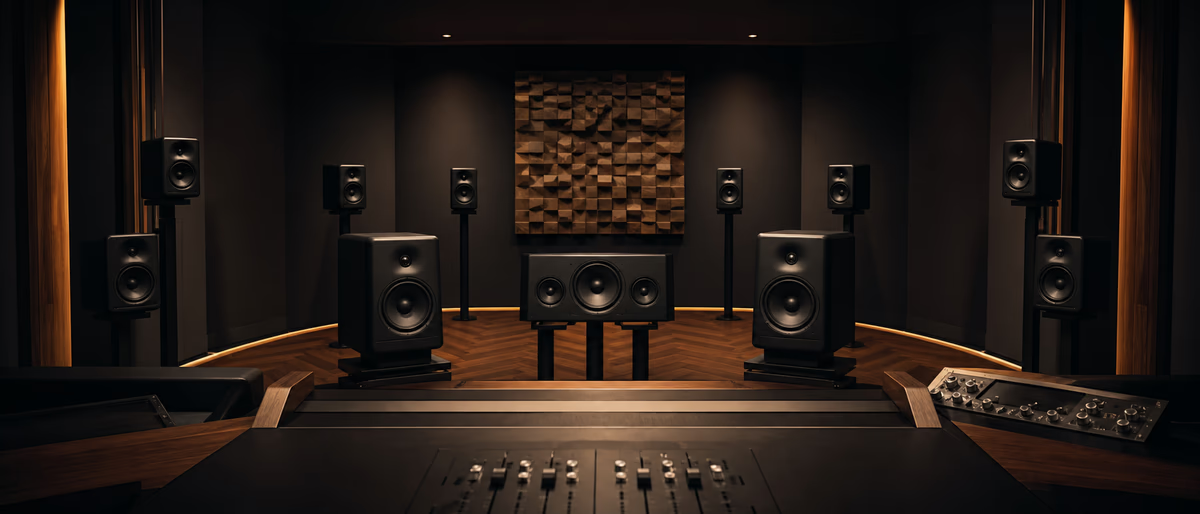
Ideal music Atmos rooms use calibrated multi-speaker layouts (often discussed around 7.1.4 for music creation) with matched levels. Many independent artists begin with headphone-centric binaural workflows plus careful speaker checks when available. Be honest about your monitoring limits when delivering commercial work. [3]
Nearfield music mixing levels commonly discussed in professional guides sit around the upper 70s to low 80s dB SPL range depending on house practice—confirm with the facility spec rather than copying a forum number blindly.
You still need a solid stereo master path. Distributors and DSPs have their own Atmos delivery requirements (ADM BWF packages, etc.). Read the current delivery notes for your distributor the week you ship; portals update.
- Translation tests Check binaural on multiple headphones and at least one speaker fold-down. Catch vanishing hard-panned objects early.
- Headroom discipline Immersive buses still clip. Leave renderer headroom and avoid stacking limiters on every object.
- Metadata hygiene Correct bed/object routing labels prevent silent stems at the plant.
A Practical First Atmos Music Pass
- Start from a great stereo multitrack
Fix balance, tuning, and noise in the source session. Atmos will not hide weak editing. - Plan the spatial story
Decide which elements are “stage” vs “space” vs “surprise.” Write a one-paragraph spatial brief. - Build bed foundation
Place core rhythm and harmony so the song still works if objects are simplified. - Assign a few meaningful objects
Prioritize signature parts. Automate movement with musical purpose tied to arrangement sections. - Render and A/B binaural vs speakers
Note elements that disappear or over-brighten. Adjust elevation and size rather than only boosting gain. - QC delivery package
Validate file type, loudness guidance from your distributor, and that the stereo master still exists as a separate approved deliverable when required.
Artistic Pitfalls
Over-separation can destroy groove glue. Some genres want the drum kit coherent, not diced across twelve locations. Use space to serve the song’s emotion: intimacy may mean less elevation, not more.
Lead vocals usually need a stable anchor. Subtle width on doubles and FX often works better than a constantly traveling dry lead that confuses lyrical focus.
Do not ignore mono/stereo fold behavior for users without Atmos playback. A huge percentage of listens still happen in non-Atmos contexts; your stereo master remains the career-critical deliverable for many releases.
Learning Path and Next Steps
Study official Dolby getting-started materials, then reverse-engineer commercial Atmos releases in your genre on a platform that offers spatial playback. Take notes on how sparse or dense the upper hemisphere feels.
Practice on one song end-to-end rather than half-finishing five. Delivery QC teaches more than endless panner experiments.
When you outgrow headphones-only, budget time in a calibrated room—even a day rate—to recalibrate your spatial instincts before taking paid Atmos clients.
Build immersive sessions on strong stereo fundamentals—grab mix tools and inspiration from Plugg Supply when you need trusted plugins and sounds.
Learning path
Answer hub terkait
Jalur pembelajaran
Tutorial dan materi pembelajaran
Tutorial langkah demi langkah dan sumber belajar untuk pembaca yang menginginkan jalur praktis lebih dalam setelah artikel.
![Udemy Dolby Atmos Music Production in Logic Pro: Spatial Audio [TUTORiAL]](/images/posts/udemy-dolby-atmos-music-production-in-logic-pro-spatial-audi-81756.avif?v=2026080101)
LEARNING / VIDEO TUTORIALS
Udemy Dolby Atmos Music Production in Logic Pro: Spatial Audio [TUTORiAL]
Katalog terkait
Lebih banyak tutorials dari katalog
Lebih banyak tutorials dari feed Plugg Supply, diberi peringkat berdasarkan popularitas katalog.
![Truefire Modern Country Rhythm [TUTORiAL]](/images/posts/truefire-modern-country-rhythm-86151.avif?v=2026080101)
LEARNING / VIDEO TUTORIALS
Truefire Modern Country Rhythm [TUTORiAL]
![Truefire Focus On Latin Bass [TUTORiAL]](/images/posts/truefire-focus-on-latin-bass-85692.avif?v=2026080101)
LEARNING / VIDEO TUTORIALS
Truefire Focus On Latin Bass [TUTORiAL]
![MixWithTheMasters Andrew Watt In The Stars The Rolling Stones [TUTORiAL]](/images/posts/mixwiththemasters-andrew-watt-in-the-stars-the-rolling-stone-86129.avif?v=2026080101)
LEARNING / VIDEO TUTORIALS
MixWithTheMasters Andrew Watt In The Stars The Rolling Stones [TUTORiAL]
![Tus Clases De Guitarra Guitarra Rítmica [TUTORiAL]](/images/posts/tus-clases-de-guitarra-guitarra-ritmica-85925.avif?v=2026080101)
LEARNING / VIDEO TUTORIALS
Tus Clases De Guitarra Guitarra Rítmica [TUTORiAL]
Artikel terkait
LEARNING / VIDEO TUTORIALS
Truefire Modern Country Rhythm [TUTORiAL]
LEARNING / VIDEO TUTORIALS
Truefire Focus On Latin Bass [TUTORiAL]
LEARNING / VIDEO TUTORIALS
MixWithTheMasters Andrew Watt In The Stars The Rolling Stones [TUTORiAL]
LEARNING / VIDEO TUTORIALS
Tus Clases De Guitarra Guitarra Rítmica [TUTORiAL]
![Udemy Singing Mastery Holistic Method To Sing Freely [TUTORiAL]](/images/posts/udemy-singing-mastery-holistic-method-to-sing-freely-86017.avif?v=2026080101)
LEARNING / VIDEO TUTORIALS
Udemy Singing Mastery Holistic Method To Sing Freely [TUTORiAL]
![MixWithTheMasters Beck Recording and Producing Ride Lonesome [TUTORiAL]](/images/posts/mixwiththemasters-beck-recording-and-producing-ride-lonesome-86013.avif?v=2026080101)
LEARNING / VIDEO TUTORIALS
MixWithTheMasters Beck Recording and Producing Ride Lonesome [TUTORiAL]
Pertanyaan yang Sering Diajukan
- Do I need a full 7.1.4 room to start learning?
- No for learning basics with binaural tools, but paid commercial work benefits from calibrated speaker checks. Be transparent about your monitoring with clients.
- Is Atmos a replacement for stereo?
- No. Stereo (and often binaural renders) still matter enormously. Treat Atmos as an additional mix, not a swap.
- Which DAW should I use?
- Use a DAW with a supported Atmos workflow you can actually run. Verify current Dolby-compatible options rather than chasing rumors of future versions.
- How loud should an Atmos music mix be?
- Follow current distributor and DSP guidance for immersive deliverables; do not assume stereo LUFS targets map one-to-one. Check the portal the week you deliver.
- Can I upmix a stereo master automatically?
- Auto-upmix tools exist as starting points but rarely match a intentional object mix from multitracks. Prefer true multitrack Atmos when quality matters.
- What is a bed in Atmos music?
- A channel-based foundation (such as 7.1.4) that carries much of the ensemble, complemented by objects with positional metadata.
- Why does my binaural render sound dull?
- Binaural processing and HRTF choices change timbre. Compare multiple headphone models and adjust bed/object tonal balance specifically for the binaural path if needed.
- Should every element move?
- No. Static, well-placed elements create a stage; motion should accent structure and emotion.